Story
Loading the latest story
Please wait while the article is prepared.
Loading article content…
Loading article content…
Story
Please wait while the article is prepared.
Loading article content…
Loading article content…

Health
The West African Society of Parenteral and Enteral Nutrition is calling for hospitals to integrate routine nutrition screening into clinical care to tackle malnutrition-related complications among patients.
The West African Society of Parenteral and Enteral Nutrition (WASPEN) has called for routine nutrition screening of patients in hospitals, stating that malnutrition should be treated as an integral part of clinical care rather than an issue addressed only after it becomes severe.
President and Founder of WASPEN, Dr. Teresa Isichei Pounds, made the call in Lagos during a press conference ahead of the 2026 Malnutrition Awareness Week, organised in collaboration with the American Society for Parenteral and Enteral Nutrition (ASPEN). Speaking on the theme, “Nutrition is a Team Effort,” Pounds emphasized that the fight against malnutrition requires stronger collaboration among healthcare professionals, government, health institutions, and communities.
Malnutrition is often discussed in terms of food insecurity, children in the community, maternal nutrition, breastfeeding and micronutrient deficiencies. These are all critical areas. But malnutrition also occurs in the healthcare setting. A patient can enter a hospital already malnourished. Another may become nutritionally depleted during an illness. Others may have increased nutritional requirements because of surgery, infection, cancer, trauma or critical illness.
— Dr. Teresa Isichei Pounds, President and Founder, WASPEN
Pounds noted that nutrition can often remain secondary to the medical condition that brought a patient to the hospital. She stressed that this approach must change if the country is serious about improving health outcomes, arguing that nutrition screening, assessment, and intervention should be considered alongside other essential components of clinical management.
According to the WASPEN founder, nutrition care should involve a multidisciplinary team including physicians, nurses, dietitians, nutritionists, pharmacists, and laboratory professionals. She clarified that while each professional brings specific expertise, the primary focus must remain on the patient’s recovery.
It means that each professional brings their expertise to the same patient, with the same goal: better outcomes and better quality of care. We must therefore move away from seeing nutrition as the responsibility or territory of one professional group. The patient should remain at the centre.
— Dr. Teresa Isichei Pounds, President and Founder, WASPEN
The upcoming 2026 campaign aims to move the conversation beyond awareness to practical action within healthcare facilities. Key focus areas include the routine identification of patients at nutritional risk, improved nutrition competencies among staff, and better access to resources for patients requiring enteral or parenteral nutrition.
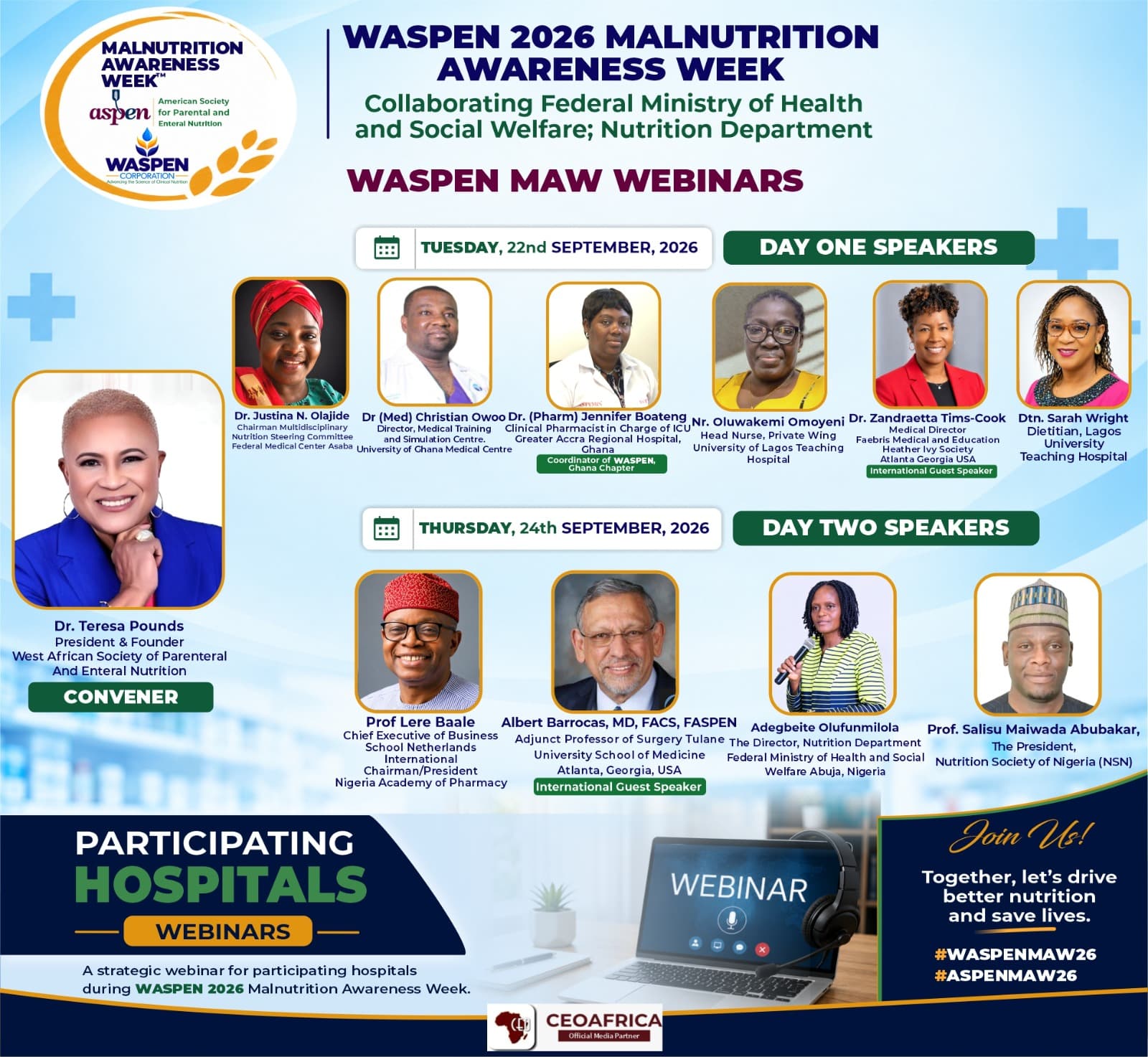
As part of the program, WASPEN will host two major webinars on September 22 and 24, 2026. These sessions will focus on defining professional roles and examining the multidisciplinary nutrition care pathway from screening to recovery. Speakers will include experts such as Dr. Justina N. Olajide, Prof. Lere Baale, and Dr. Christian Owoo, among others.
WASPEN has already helped establish approximately six multidisciplinary teams in various institutions across Lagos, Abuja, and Asaba. These teams are formed through memorandums of understanding with the Chief Medical Directors of the institutions to ensure long-term collaboration and education.
Dr. Justina N. Olajide, Chairman of the Multidisciplinary Nutrition Steering Committee at the Federal Medical Center (FMC) Asaba, detailed the local plans for Malnutrition Awareness Week. The activities, scheduled for September 21 to 25, 2026, will include sensitisation for healthcare workers, anthropometric measurements of hospital staff, and clinical presentations.
On Wednesday, we will engage hospital staff. We want to measure their BMI, height and weight, carry out anthropometric measurements and document findings on the prevalence of malnutrition within the hospital and other areas as much as possible.
— Dr. Justina N. Olajide, Chairman, Multidisciplinary Nutrition Steering Committee, Federal Medical Center Asaba
Pounds concluded by urging the Federal Government to ensure the national nutrition agenda covers the full continuum of care, bridging the gap between community interventions and hospital-based clinical management. She maintained that because malnutrition is complex, it requires a national responsibility and a unified healthcare response.