Story
Loading the latest story
Please wait while the article is prepared.
Loading article content…
Loading article content…
Story
Please wait while the article is prepared.
Loading article content…
Loading article content…

Education
WAEC debt crisis leaves thousands of students in limbo as 1.2 million shine in 2026 WASSCE
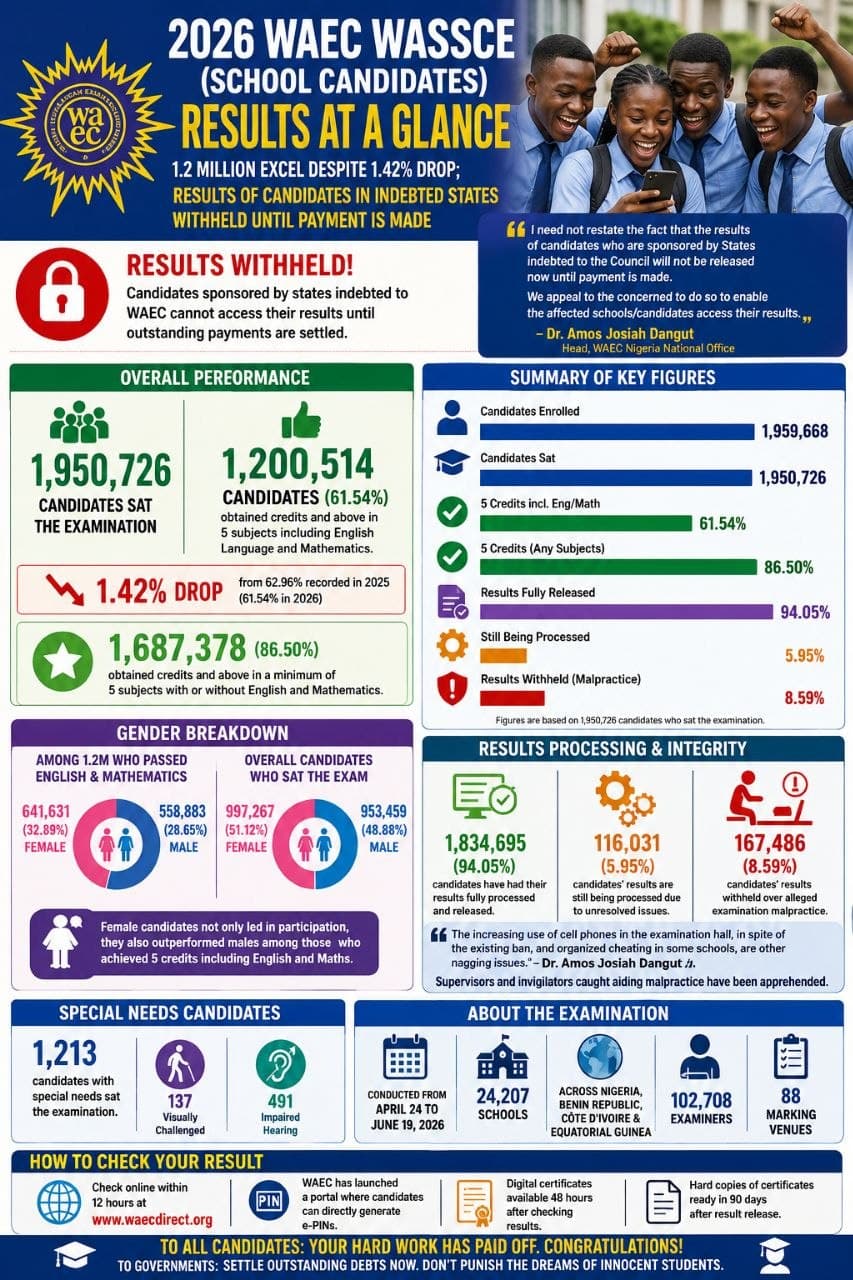
For thousands of students across Nigeria, Wednesday should have been a day of celebration after months of hard work and anxious anticipation. Instead, many were left staring at blank screens, unable to access the results that could determine their admission into tertiary institutions. This delay is not due to academic performance, but because their state governments have allegedly failed to pay examination fees.
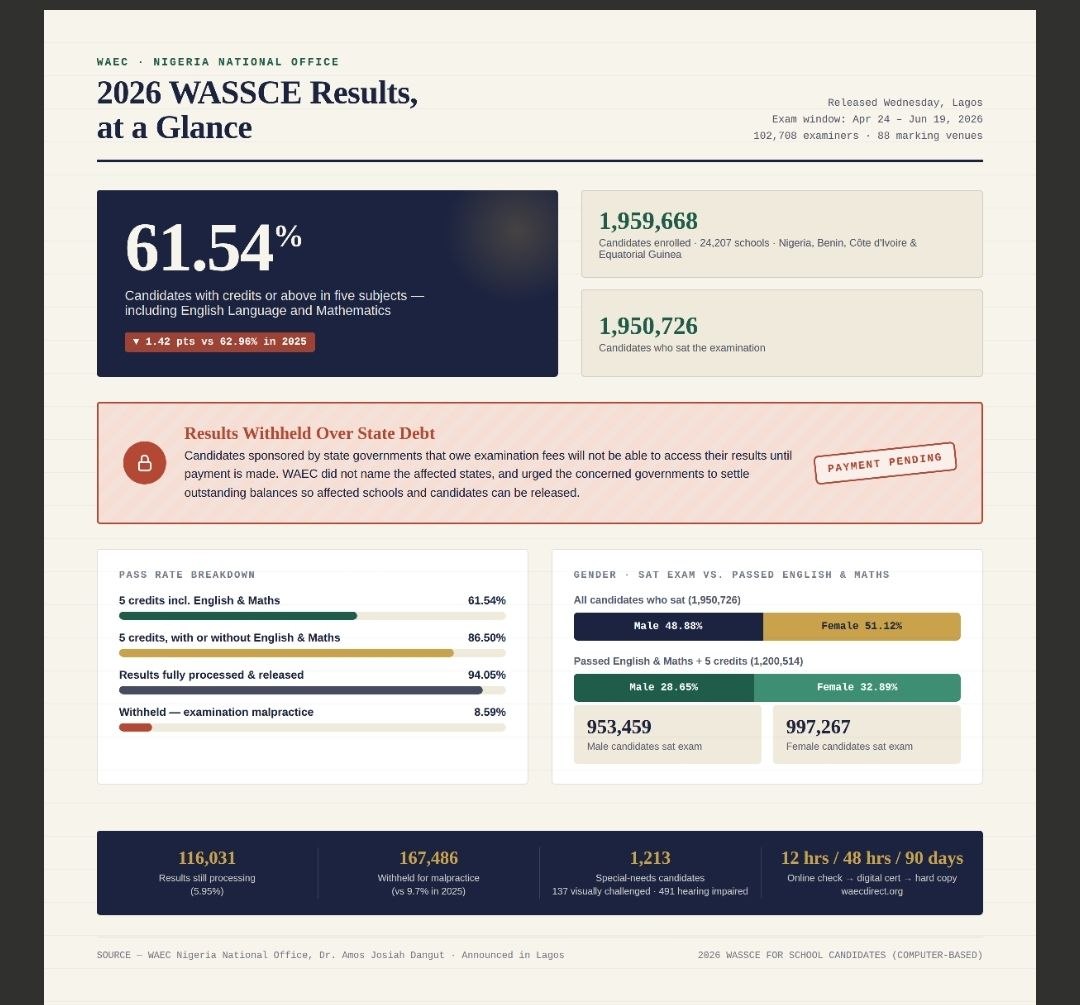
The West African Examinations Council (WAEC) announced the release of the 2026 Computer-Based West African Senior School Certificate Examination (WASSCE) results for School Candidates, revealing that candidates sponsored by states indebted to the Council will remain locked out of the portal until outstanding debts are settled.
I need not restate the fact that the results of candidates who are sponsored by States indebted to the Council will not be released now until payment is made.
— Dr. Amos Josiah Dangut, Head of the Nigeria National Office, WAEC
Dr. Dangut appealed to the concerned state governments to urgently clear their financial obligations to spare innocent candidates from further anxiety. While the Council declined to disclose the identities of the specific indebted states, the impact is immediate, as the delay could mean missing admission deadlines and scholarship opportunities for affected students.
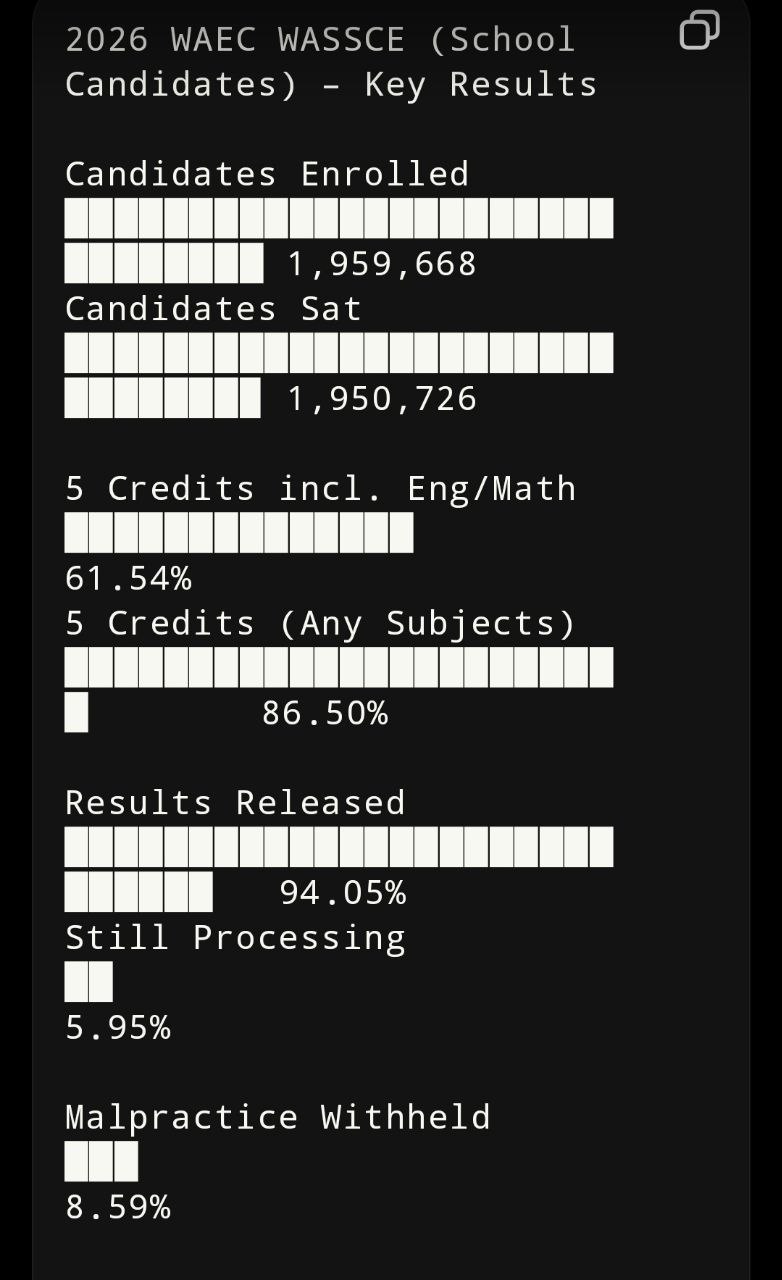
Despite the financial setbacks affecting specific regions, the Council reported an encouraging overall performance for the 2026 session. Out of the 1,950,726 candidates who sat the examination, 1,200,514 candidates—representing 61.54 per cent—obtained credits and above in a minimum of five subjects, including English Language and Mathematics.
While these results are commendable, they represent a slight decline from the 62.96 per cent recorded in the 2025 examination. Similarly, 1,687,378 candidates, representing 86.50 per cent, obtained credits and above in at least five subjects, with or without English Language and Mathematics.
Female candidates recorded a stronger performance among those who achieved the benchmark of five credits including core subjects. According to WAEC, 641,631 successful candidates (32.89 per cent) were female, while 558,883 candidates (28.65 per cent) were male. Overall participation also reflected a slight female majority, with 997,267 females and 953,459 males sitting for the examination.
Regarding result processing, Dr. Dangut disclosed that 1,834,695 candidates, representing 94.05 per cent, had their results fully processed and released. However, 116,031 candidates (5.95 per cent) still have their results undergoing processing due to unresolved technical or administrative issues.
The Council also withheld the results of 167,486 candidates, representing 8.59 per cent of those who sat the examination, over alleged involvement in examination malpractice. Although malpractice remains a concern, this figure represents an improvement over the 9.7 per cent recorded in the 2025 cycle.
The increasing use of cell phones in the examination hall, in spite of the existing ban, and organized cheating in some schools, are other nagging issues.
— Dr. Amos Josiah Dangut, Head of the Nigeria National Office, WAEC
Dr. Dangut noted that supervisors and invigilators found aiding malpractice had been apprehended and would face appropriate sanctions. The Council expressed concern over the growing sophistication of cheating methods despite existing bans on electronic devices.
WAEC reaffirmed its commitment to inclusive education, revealing that 1,213 candidates with special needs participated in the examination. This included 137 visually challenged candidates and 491 candidates with impaired hearing, for whom specific accommodations were made during the testing process.
The 2026 WASSCE was conducted between April 24 and June 19 across Nigeria, Benin Republic, Côte d'Ivoire, and Equatorial Guinea, involving 24,207 schools. A total of 102,708 examiners participated in marking scripts across 88 marking venues to ensure the timely release of data for the majority of candidates.
Candidates whose results have been released can check them online via the WAEC result portal. The Council has introduced a platform for candidates to generate electronic PINs directly, while digital certificates will become available 48 hours after result checking. Despite these advancements, the academic future of thousands remains dependent on state governments fulfilling their financial obligations.