Story
Loading the latest story
Please wait while the article is prepared.
Loading article content…
Loading article content…
Story
Please wait while the article is prepared.
Loading article content…
Loading article content…

Politics
The Nigerian Senate has passed significant amendments to the FRSC Act, introducing a N50,000 fine for hawking and preaching in commercial vehicles to improve road safety. The new legislation drastically increases penalties for traffic violations, including a 300 percent hike in fines for driving under the influence.
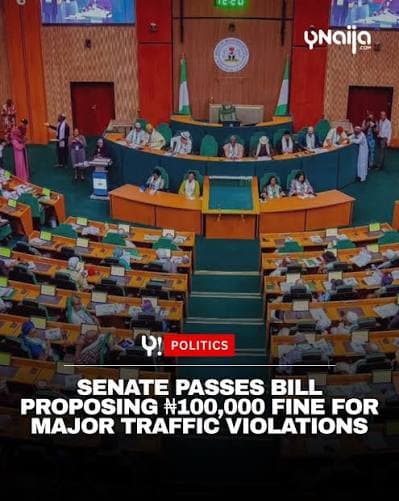
For years, they have been familiar faces on Nigeria's roads: the woman weaving through traffic to sell bottled water, the young man preaching passionately inside a crowded commercial bus, and the driver who answers phone calls while navigating chaotic streets. For many commuters, these activities have become an expected part of the daily journey, but that reality may soon change following new legislative action.
The Senate has passed amendments to the Federal Road Safety Commission (FRSC) Act, introducing significantly stiffer penalties for traffic offences. Lawmakers describe the move as a decisive step toward saving lives and restoring discipline on Nigerian roads. Among the most discussed provisions is the reinforcement of a N50,000 fine for anyone found hawking, trading, or preaching inside commercial vehicles, a development expected to reshape the everyday experience in buses across the country.
The amendment bill, titled Federal Road Safety Corps Act (Amendment), 2026 (HBs. 1401 & 1604 – For Concurrence), raises fines for several traffic violations by as much as 300 per cent. This reflects growing concern over reckless driving and avoidable road crashes. During the debate, senators argued that distractions inside moving vehicles have contributed heavily to unsafe driving conditions.
Our roads have become marketplaces and crusade grounds. This cannot continue. The penalties must hurt enough to change behaviour.
— Unnamed Lawmaker, Member, Nigerian Senate
Beyond hawking and preaching, the amendment introduces tougher consequences for motorists who violate key regulations. Driving under the influence of alcohol, which previously attracted a N5,000 fine, will now attract N100,000, two years' imprisonment, or both upon conviction. The law also targets motorists who refuse to cooperate with FRSC officials during roadside breath tests; such refusal will now attract a N50,000 fine, six months' imprisonment, or both.
A person who, while driving or attempting to drive, or when in charge of a motor vehicle, is under the influence of intoxicating drugs or alcohol above the legal limit or to such an extent as to be incapable of having proper control of such motor vehicle, commits an offence and is liable on conviction to a fine of N100,000 or imprisonment for a term not exceeding two years or both.
— Federal Road Safety Corps Act (Amendment) 2026, Legislative Document
Other offences affected by the review include speeding, reckless driving, failure to obey traffic lights, and seatbelt violations. Failure to obey traffic lights, road signs, or pavement markings will now attract a N100,000 fine. Speeding offences and reckless driving will carry the same financial penalty, with reckless driving also potentially resulting in a two-year jail term.
The second schedule of the amended Act lists 52 offences and their corresponding penalties, all of which will come into effect after presidential assent. For transport operators and daily commuters in urban centres like Lagos and Abuja, the amendment marks the beginning of a significant behavioural shift. The familiar voices offering prayers or household items during bus journeys may soon fade as the financial consequences become considerably steeper.
The FRSC has consistently maintained that weak penalties encouraged widespread disregard for traffic regulations in the past. With this latest amendment, lawmakers believe compliance will no longer be a matter of convenience but one of costly consequences. If signed into law, the legislation could redefine the passenger experience, turning buses back into places of transportation rather than moving marketplaces or pulpits.