Story
Loading the latest story
Please wait while the article is prepared.
Loading article content…
Loading article content…
Story
Please wait while the article is prepared.
Loading article content…
Loading article content…

World
Professor Samuel Achilefu has developed wearable medical vision goggles that use fluorescence imaging to help surgeons identify and remove microscopic cancer cells in real-time. This breakthrough technology aims to reduce cancer recurrence by visualizing tumors that are often invisible to the naked eye.
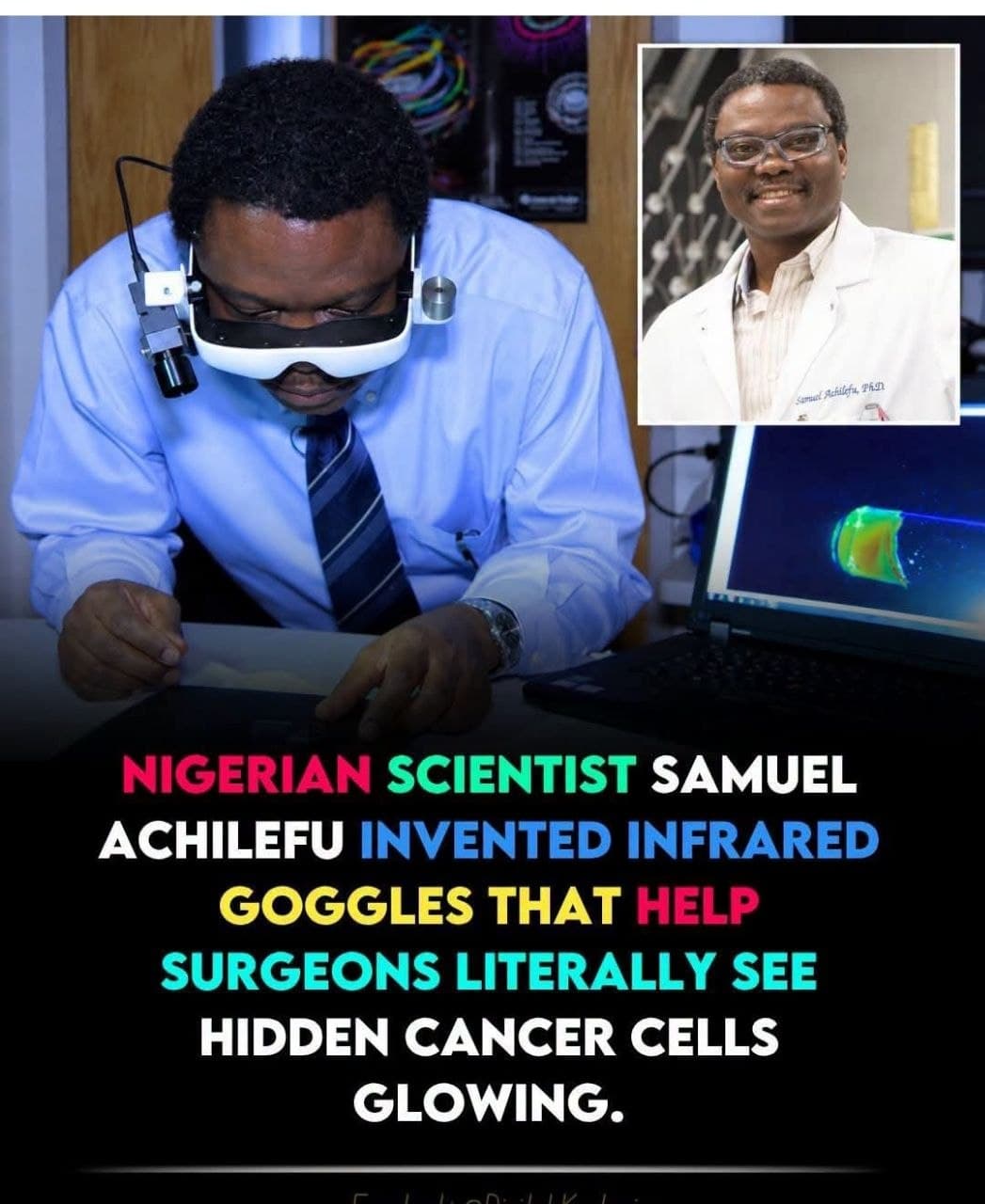
Nigerian-born scientist and biomedical engineer, Professor Samuel Achilefu, has developed a wearable medical imaging technology that enables surgeons to visualise cancerous cells during surgery — a breakthrough designed to help doctors detect and remove tumour remnants that may otherwise be invisible to the naked eye.
The technology, known as Medical Vision Goggles, uses fluorescence imaging to make cancer cells glow under special near-infrared light, giving surgeons real-time visual guidance while operating.
Achilefu, Professor of Biomedical Engineering and Radiology at UT Southwestern Medical Center, built the technology from his pioneering work in molecular imaging of cancer.
A contrast agent is administered to the patient and attaches to cancer cells. When exposed to special light, the agent causes the cancerous tissue to emit a near-infrared signal, which the goggles' camera detects and converts into a visible overlay for the surgeon. This allows the surgeon to view the patient's anatomy while simultaneously seeing highlighted areas where residual cancer cells may be present — without looking away from the surgical field. The technology addresses one of the core challenges in cancer surgery: distinguishing cancerous tissue from healthy tissue during an operation.
Cancer cells can be difficult to identify with the naked eye, creating the risk that microscopic tumour cells could remain after surgery and trigger recurrence.
Removing a small margin of healthy cells around tumours and any remnant cells reduces the risk of cancer recurrence and the need for future surgeries.
— UT Southwestern
The roots of the innovation date to Achilefu's earlier work at Washington University School of Medicine in St. Louis. The technology was first used during surgery at Siteman Cancer Center at Barnes-Jewish Hospital in February 2014, when breast surgeon Julie Margenthaler used the glasses to visualise cancer cells in a patient.
Our hope is that this new technology will reduce or ideally eliminate the need for a second surgery
— Margenthaler
Early research showed the technology could detect tumours as small as 1mm in diameter. Fellow surgeon Ryan Fields described what made it significant: "A limitation of surgery is that it's not always clear to the naked eye the distinction between normal tissue and cancerous tissue. With the glasses developed by Dr. Achilefu, we can better identify the tissue that must be removed."
From Night-Vision to Cancer Detection The idea for the goggles emerged after conversations with surgical fellows who told Achilefu that conventional fluorescence-guided surgery methods — which often require bulky equipment, large screens and additional specialists — could make it time-consuming to locate residual cancer cells.
"We wondered, 'Could we use that same technology to make cancer the enemy we seek to find in the dark?'" he recalled. The resulting technology evolved through several iterations, with a wearable optical see-through device developed in 2017. UT Southwestern says early results indicate the Medical Vision Goggles perform comparably to existing fluorescence-guided surgery systems while offering a smaller and potentially more accessible platform. The Scientist Behind the Breakthrough Achilefu joined UT Southwestern in 2022 as the inaugural Chair of Biomedical Engineering. He holds more than 70 United States patents and has published more than 300 scientific papers, with his work focused on molecular imaging, cancer detection and nanotechnology — particularly in breast cancer applications. In 2025, he was elected to the United States National Academy of Engineering, becoming the first UT Southwestern faculty member to receive the distinction. He is also a member of the National Academy of Medicine and a Fellow of the National Academy of Inventors. For Achilefu, the work is about more than building devices. "Every cancer patient should get the best care, and we hope the technology behind the Medical Vision Goggles will lead to more medical innovations," he said. From a first experiment in a St. Louis operating room to an advanced wearable imaging system at one of America's leading medical institutions, Achilefu's work illustrates how biomedical engineering is being applied to one of surgery's most persistent challenges — helping surgeons identify what the human eye cannot easily see.